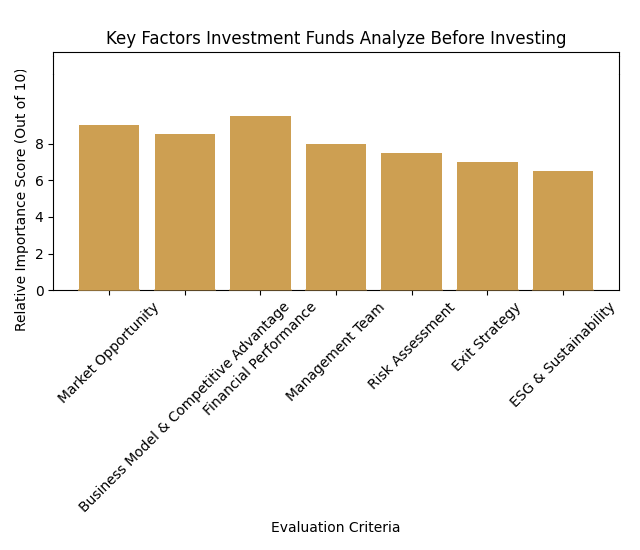
In today’s increasingly competitive capital markets, attracting institutional investment is not just about having a promising idea or a compelling pitch deck. Investment funds operate under strict risk-return frameworks and deploy capital only after a rigorous evaluation process.
Understanding what professional investors analyze before committing capital can help founders position their companies more effectively, assist bankers in structuring transactions, and provide students of finance with real-world insight into investment decision-making.
Below are the core pillars that investment funds typically assess before investing in a company.
1. Market Opportunity and Growth Potential
Investment funds rarely invest in businesses that operate in stagnant or shrinking markets. The first question most investors ask is simple:
Is the market large enough to justify the investment?
Funds typically evaluate:
Total Addressable Market (TAM)
Market growth rate
Industry trends and macroeconomic drivers
Competitive landscape
Companies operating in high-growth sectors or markets undergoing structural transformation often attract greater investor interest. Beyond market size, funds also analyze whether the company can realistically capture and expand its market share.
Scalability is especially critical for venture capital and growth equity investors, as their return expectations depend heavily on rapid expansion potential.
2. Business Model and Competitive Advantage
A strong business model demonstrates not only how a company generates revenue, but also how sustainable and defensible that revenue stream is.
Investment funds typically focus on:
Revenue generation mechanisms
Customer acquisition strategy
Pricing power
Cost structure efficiency
Barriers to entry
Companies with clear competitive advantages, such as proprietary technology, intellectual property, network effects, or strong brand positioning, are significantly more attractive to investors.
In highly competitive industries, differentiation can be the deciding factor between securing funding and being overlooked.
3. Financial Performance and Key Metrics
Financial analysis remains one of the most decisive components of any investment evaluation. Funds analyze both historical performance and forward-looking projections.
Key metrics typically include:
Profitability Indicators
EBITDA margins
Gross margin trends
Net profitability
Growth Metrics
Revenue growth rate
Customer expansion
Market penetration progress
Efficiency Metrics
Customer Acquisition Cost (CAC)
Lifetime Value (LTV)
Operating leverage
Burn rate (particularly in early-stage companies)
Investment funds also pay close attention to the quality and realism of financial forecasts. Overly optimistic projections without supporting assumptions often reduce investor confidence.
4. Management Team and Leadership Quality
Many experienced investors emphasize that they invest in people as much as they invest in business models.
Funds carefully assess:
Founders’ track record and industry expertise
Leadership capability and execution skills
Team complementarity and organizational structure
Ability to adapt to market changes
A strong, credible, and experienced management team significantly reduces execution risk. Investors often view resilient leadership as a critical factor in navigating market volatility and scaling operations successfully.
5. Risk Assessment and Due Diligence
Every investment involves risk, but funds systematically evaluate and quantify potential downside exposure through comprehensive due diligence.
Key risk areas include:
Financial stability and liquidity risk
Regulatory and compliance exposure
Operational and supply chain vulnerabilities
Legal and contractual risks
Customer concentration dependency
Technology or product viability risks
Investors typically prefer companies that demonstrate strong risk management processes and transparent governance structures.
6. Exit Strategy and Return Potential
Investment funds operate with defined investment horizons and must consider how they will eventually monetize their investment.
Common exit routes include:
Initial Public Offerings (IPO)
Strategic acquisitions
Secondary buyouts
Management buybacks
Funds analyze whether realistic exit opportunities exist within a reasonable timeframe. Even highly profitable companies may struggle to attract investment if clear liquidity pathways are not visible.
7. ESG and Sustainability Considerations
Environmental, Social, and Governance (ESG) factors are becoming increasingly influential in investment decision-making, particularly among institutional investors.
Funds may evaluate:
Environmental impact and sustainability practices
Corporate governance standards
Social responsibility and stakeholder management
Diversity and inclusion policies
Companies that integrate ESG principles into their strategy often benefit from improved risk profiles and enhanced investor appeal.
8. Strategic Fit Within the Fund’s Portfolio
Even strong companies may not receive investment if they do not align with a fund’s specific mandate or portfolio strategy.
Investment funds consider:
Industry specialization
Geographic focus
Investment stage preference
Portfolio diversification needs
Synergies with existing investments
Understanding an investor’s thesis before approaching them significantly increases the probability of securing capital.
Final Thoughts: Investment Readiness Is a Strategic Process
Securing investment from professional funds is rarely the result of a single successful presentation. It is the outcome of building a scalable business, demonstrating consistent performance, maintaining transparency, and aligning with investor expectations.
For entrepreneurs, understanding how funds evaluate opportunities is essential for preparing effective fundraising strategies. For bankers and financial advisors, it supports better transaction structuring and client positioning. For students of finance, it provides a practical framework that bridges academic theory with real-world capital allocation.
Companies that proactively address these evaluation pillars are not only more likely to attract investment, but also better positioned for sustainable long-term growth.